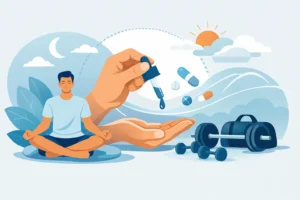

Three weeks in, most people are not talking about fireworks. They are talking about subtler wins – getting out of bed without a fight, feeling less snagged by spiralling thoughts, finding work a little less heavy, and hearing their own inner voice with less static. That is why the idea of a 90 day microdosing experience keeps pulling people in. It promises neither instant salvation nor empty hype, but a longer arc – one built on consistency, observation and small shifts that can add up.
This matters because microdosing sits in a strange place. It is part ritual, part experiment, part wellness practice, and part rebellion against the idea that healing must always follow a conventional script. For people looking for mood support, emotional reset, creative lift or a different relationship with anxiety, 90 days feels long enough to move beyond novelty and see whether anything real is happening.
What a 90 day microdosing experience really is
A genuine 90 day microdosing experience is not about tripping lightly every morning and hoping for the best. It is a structured period of taking very small, sub-perceptual or near sub-perceptual doses on a planned schedule, then paying close attention to what changes over time. The emphasis is on pattern, not intensity.
That distinction matters. If the dose is high enough to dominate your day, it stops being microdosing in any practical sense. The point is to support function, not derail it. People usually approach this kind of cycle because they want to stay present in ordinary life – work, relationships, training, journalling, therapy, rest – while nudging perception and mood in a different direction.
Over 90 days, the experience tends to become less about the compound alone and more about the system around it. Sleep quality, stress load, social environment, diet, emotional honesty and expectations all start showing their hand. Microdosing can amplify what is already there. For some, that feels liberating. For others, it is confronting.
The first month of a 90 day microdosing experience
The first two weeks are often full of projection. People want to know quickly whether they have found the missing piece. Sometimes there is a gentle lift in energy, a slightly brighter mood, more patience, or a sense that creative blocks are loosening. Sometimes there is almost nothing obvious at all.
That does not automatically mean it is working or not working. Early changes are notoriously hard to read because expectation can colour everything. If someone begins a 90 day microdosing experience already primed for breakthrough, every decent day can feel like proof. If they begin exhausted and sceptical, real improvements can be dismissed as coincidence.
By weeks three and four, the novelty usually wears off. This is actually useful. The performative side drops away, and what remains is the quieter question: am I functioning differently in ways that matter? People often report steadier emotional recovery after stress, less mental drag, a bit more openness in conversation, or a stronger pull towards habits that support them rather than sabotage them.
There is a flip side. The first month can also reveal friction. Irritability, restlessness, poor timing, unrealistic dose choices, or the temptation to increase frequency too quickly can all muddy the picture. A longer framework helps because one off highs and lows mean less when measured against a full 90 days.
What tends to change in the middle stretch
The middle phase is where a 90 day microdosing experience either becomes meaningful or starts to feel cosmetic. Around the second month, you are no longer testing curiosity. You are testing consistency.
For many people, this is when the strongest benefits show up in ordinary settings. Work may feel less fragmented. Emotional reactions may become easier to catch before they run away. Time outdoors, music, movement and reflection can feel more available rather than like chores. The change is rarely cinematic. It is more like noticing that you have a few more degrees of freedom inside your own day.
That modesty is part of the appeal. Big, dramatic claims sound seductive, but sustainable change is often quieter. A person who is less overwhelmed by emails, more able to tolerate discomfort, and less likely to disappear into anxious loops may not sound transformed on paper. In lived experience, that can be huge.
The middle stretch also exposes one of the central truths of microdosing: it is not a substitute for inner work. If someone is ignoring burnout, staying in punishing routines, numbing themselves every night, or refusing to face difficult relationship dynamics, a small psychedelic dose will not magically organise their life. It may even make that misalignment harder to ignore.
What the final month often reveals
By the last 30 days, the most useful question is not, do I feel something today? It is, am I different from where I started? This is where journalling, mood tracking and honest comparison become valuable.
Some people finish a 90 day microdosing experience and realise the shift has been cumulative. They are calmer, more engaged, less depressive in tone, and more in touch with purpose. Others find the gains were real but limited – a helpful support, not a cure. And some conclude that the practice did not suit them, or that their dosing pattern was off, or that the compound they chose was not the right fit.
That is worth saying plainly. A 90 day cycle is not proof of universal effectiveness. Bodies differ. Minds differ. Context differs. What feels clarifying for one person can feel flat or destabilising for another.
There can also be a subtle dependence on the idea of the protocol itself. People sometimes become attached to the narrative that they are on a healing path simply because they are following a schedule. The last month is a good time to test whether the deeper changes – better boundaries, steadier mood practices, stronger self-awareness – can stand on their own.
What can improve, and what can disappoint
The strongest reports from a 90 day microdosing experience usually centre on mood, focus, creativity, self-reflection and emotional flexibility. People may feel less stuck. They may have an easier time interrupting negative mental loops. They may reconnect with a sense of curiosity that felt buried under stress or low mood.
But there are trade-offs. Subtle effects can be hard to separate from placebo, routine changes or seasonal factors. Benefits may plateau. Tolerance and timing can complicate results. And if someone is chasing a dramatic emotional rescue, the experience may feel underwhelming.
There is also the question of pressure. Turning microdosing into a performance metric can drain the value from it. If every day becomes a test of whether your brain has finally become the version you wanted, the practice can start feeding anxiety instead of easing it.
Why structure matters more than hype
The people who tend to get the most out of a 90 day microdosing experience are rarely the ones chasing spectacle. They are the ones treating it as a disciplined relationship with change. That means intentional scheduling, realistic dose awareness, supportive habits and enough patience to notice subtle trends.
It also means respecting the line between experimentation and carelessness. Psychedelic compounds are not lifestyle accessories. They alter perception, affect and inner processing. Even at small doses, mindset and context matter. So does restraint.
For people who are serious about this space, quality and consistency of sourcing matter too. That is part of why specialist platforms such as Lysericmeds.shop speak to a growing audience looking for access that aligns with a broader transformation journey rather than a random purchase.
Is a 90 day microdosing experience worth it?
If you want a quick thrill, probably not. If you want a tidy miracle, probably not either. But if you are drawn to subtle change, honest self-observation and a more intentional relationship with mood and consciousness, 90 days is long enough to teach you something real.
The most valuable outcome may not be feeling permanently brighter or sharper. It may be understanding your own patterns with more clarity – what supports you, what drains you, what you have been avoiding, and what kind of inner work actually helps. Sometimes that is the shift people were looking for all along.
Approach it with respect, not fantasy. Give the process room to speak in small ways. The loudest transformation is not always the deepest one.